“Stick in the Mud!”

Here, I’ve embedded an MP4 which is an update of an animation that I recently created in Adobe’s Animate. It is based on a photo I’d taken several years ago of sticks arranged on the beach which I imagined to be participating in the action that I’ve cast. After I’d taken a photo of the arrangement, I worked the image up in Photoshop for color and contrast levels. I’ve also used the original image in a number of paintings.

For me, the whole set-up is simply intended to be whimsical, farcical, imaginary, with no particular bent toward politics or social commentary. That said, if it evokes anything, I’d have it be a nod to the ineluctable tendency toward competition extant sentient forms at large, with emphasis on ‘at large’.

In this new iteration, I generally tightened up most of the action, striving for better continuity between symbols, compositions, shadows and so forth. I attempted to add some more ‘natural’ movement to the big stick on the left, to make it look more like it was walking (than it had before) by rotating the form back and forth over the timeline using the Free Transform Tool. I created a new shadow for this ‘advancing stick’ tailored to local colors in the animation, and attempted to get this shadow to conform to all the other shadows–and its source–over the timeline. I opted not to use the bone tool, to keep shapes and actions more or less contextual with one another.

I added several seconds of frames to the beginning of the timeline in order to give some space to the introductory retreat march. The drums start first, then the pipes come in as the camera pulls back and pans to the left to introduce the action. A crowd booing comes in three seconds after the pipes start, followed by two more instances of the file. The booing fades out over the last few seconds of each instance. The Scottish march was available as a public domain file. I found most of the other sounds at a site that offers royalty free files.

At 2 ½ seconds a big storm cloud, snipped from an earlier cloud file, comes in from the left and hovers over the big stick on the right.

At 6 ½ seconds the big stick on the left enters, shouting, “Stick in the Mud!”This dialogue bubble is a symbol that I created in Illustrator, exported to Animator.

Next, Giggling is heard as the dialogue bubblefades away into the sky. As the dialogue bubble disappears, the storm cloud sends out thunder soundandlightning flasheswhile the dialogue bubble”OW!” appears. I created these symbols in Illustrator.

Flames, that I created in Illustrator with a radial gradient, appear on the back of the big stick on the right. I applied about an eight to ten-pixel blurto them in Animate, while morphing them with the Free Transform Tool over the timeline.Giggling is once again heard when the fire starts. In each instance of the giggling, the soundfades in,then fades out.

Grazing Deer Alter Forest Acoustics

I live near Ocean Shores. Since I was a small child, it has become a ‘deer town’ like other small rural towns become ‘dog towns’. You cannot drive a quarter mile without seeing deer along the shoulders of the road, lurking in yards, eating anything low-lying, especially garden stuff, and you can often see them emerging from hotel and motel common area backyards munching on bread and crackers that tourists get a kick out of feeding them. Frequently, you’ll see their carcasses lining the roads, although city management does a pretty good job of keeping them picked up.

In earlier times, deer were scant–or not so readily seen–in these parts as there was regular hunting all around. Too, there was no Ocean Shores–particularly with a human population that finds it endearing today that the deer abound. Oh, I have lots of deer that come through my place here in Ocean City, five miles separated from Ocean Shores. They’ll often spend entire days just lounging around in my little meadows. But I never feed them, nor get close to them, nor try to make buddies with them. And, they have to jump a five-foot fence to get in here, but I assuredly don’t invite them in, nor do I harass them once they are in.

I’m not so sure that I agree with the tenets of the claims made in this podcast, as the speakers don’t consider other terrain-altering happenstances, like land clearing and building, roads construction, wild land fires, other natural forms of environmental change–including insect damage.

In Ocean Shores, one of the biggest contributors to the deer population are the people who feed them daily, continually, with all manner of things that the deer really shouldn’t have. If you go to the local grocery store, it’s not unusual to hear one of the produce managers fielding questions about ‘deer apples’: “Nah, not right now. So-and-so came in and bought the last hundred pounds. We have some coming in Wednesday though. Come back then,” things like that.

The podcast I’ve selected, suggests another potentially negative impact–particularly to the deer themselves–from overpopulation and overgrazing of the woodland under story: The alteration of wild sound quality due to reduced sound-deflecting and buffering materials. All things being equal, in Ocean Shores it doesn’t seem to be much of a problem as such grazing seems to lend to a robustness of the brush.

My Backyard

When I lived in California, I spent a fair amount of time camping, hiking and exploring the northern half of the state, in the back county and along the coast. There was one moment on a beautiful, late spring day at Yosemite National Park, and I and my friends were late leaving. The sun had just started to set…and Half Dome became ablaze with alpenglow.

I’d known the reason, for years, that a pronounced red color shift takes place at the end of the day when the sun is at its lowest, when there are fewer air molecules and other particulates to scatter light. Otherwise, when the sun is highest, blue (sky) light gets through, as those wavelengths are short and capable of dodging obstacles…like molecules of oxygen. It’s because those red wave lengths of light have little resistance, and like to travel long and low at the end of the day, that we get to see so much of them just before dusk.

I’d also seen that phenomenon in pictures–in books–describing the changing colors and textures of alpine environments as the daylight itself changed. My first glimpse of those images caused me to chortle, as they seemed artificial, made by photographic trickery. But then I beheld that image at Yosemite, in real time, in real space. Since, I have paid keener attention to how things look in the waning light, particularly with that dramatic shift.

Still, I don’t think I’d ever perceived alpenglow–or, paid much attention to it–until a girlfriend named it for me. After, I seemed to see it everywhere: on skyscrapers in San Francisco (when it wasn’t fogged in); all along the East Bay hills, reflected in the window glass of homes there (such that it often looked like they were on fire. That, especially after the actual Oakland Hills Fire in 1990).

Alpenglow on the swamp spruces

Then, one day, I was out looking for one of my kitties, when something out of my periphery in the eastern sky caught my attention. For the next five minutes, I managed to watch and record alpenglow on the spruces, from such a view they were framed by everything else.

Had I never seen that before? Those trees have been there since well before I was born, before I began to wander around these grounds. Did no one ever say, “Oh, Ron, look at how beautiful the spruce trees are, all alight with sunset!” Funny, how much of life we go through before being able to simply see.

Crystal Curtain

It has been cold lately. Then why shouldn’t it be? It’s the first of February after all, and in these parts, February is often colder than December or January. This is the time when we most often see interesting changes to the landscape wrought by temperature extremes or dramatic storms.

Crystal Curtain

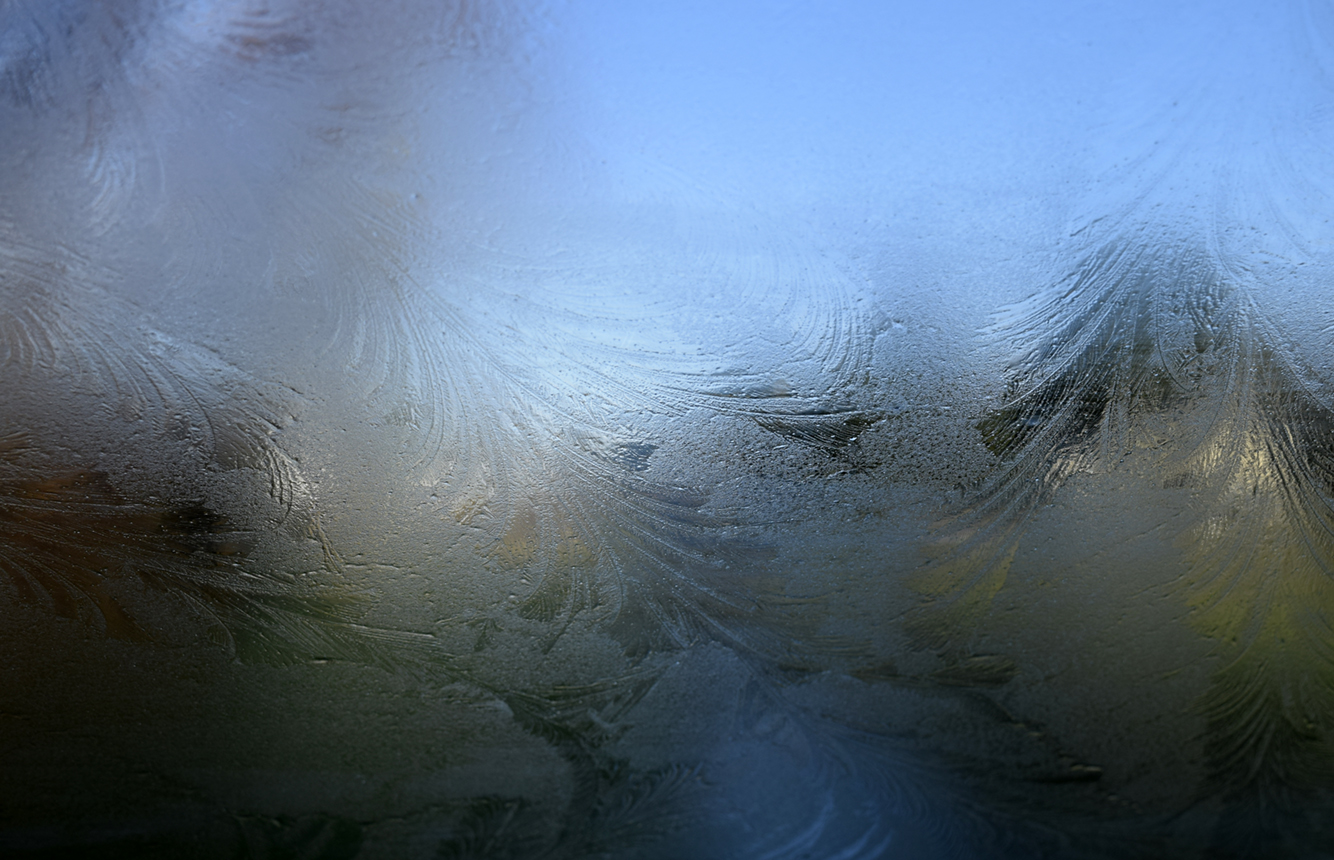
The other day, I got into my car to drive to the nearest town of commercial significance, to get some groceries, stock up on the larder, find something new and interesting that the cat might eat. He’s picky when it’s cold, and we’d run out of the standbys. All the windows of the car were iced over and I had no scraper. Still, the passenger side had a beautiful pattern that reminded me of icy feathers arrayed along a translucent plane. Colors and forms of things that sifted through were from things in the distance, the crystals permitting only an abstract sense of what those things were. From the composition, I got a sense of the sun coming up behind a tree-lined backdrop. Often, If I’m up early enough, and the sky is clear, I do get to see that but from a different angle. This time, that image was actually the neighbor’s garage door, contrasted by the colors of the house and its roof line to which the structures belonged, but the ice crystals caused me to perceive something else.

As I regarded the scene, it occurred to me how readily we prefer to see things through just such a gauze. Before turning on the car’s engine and heater to clear up my view, I wondered to myself, what might someone else have perceived in such a scene, even while knowing from experience what is actually there. How have you, the reader of this essay, ‘re-presented’ early memories or spruced them up? Over what have you drawn or do you presently draw a crystal curtain?

Queens!

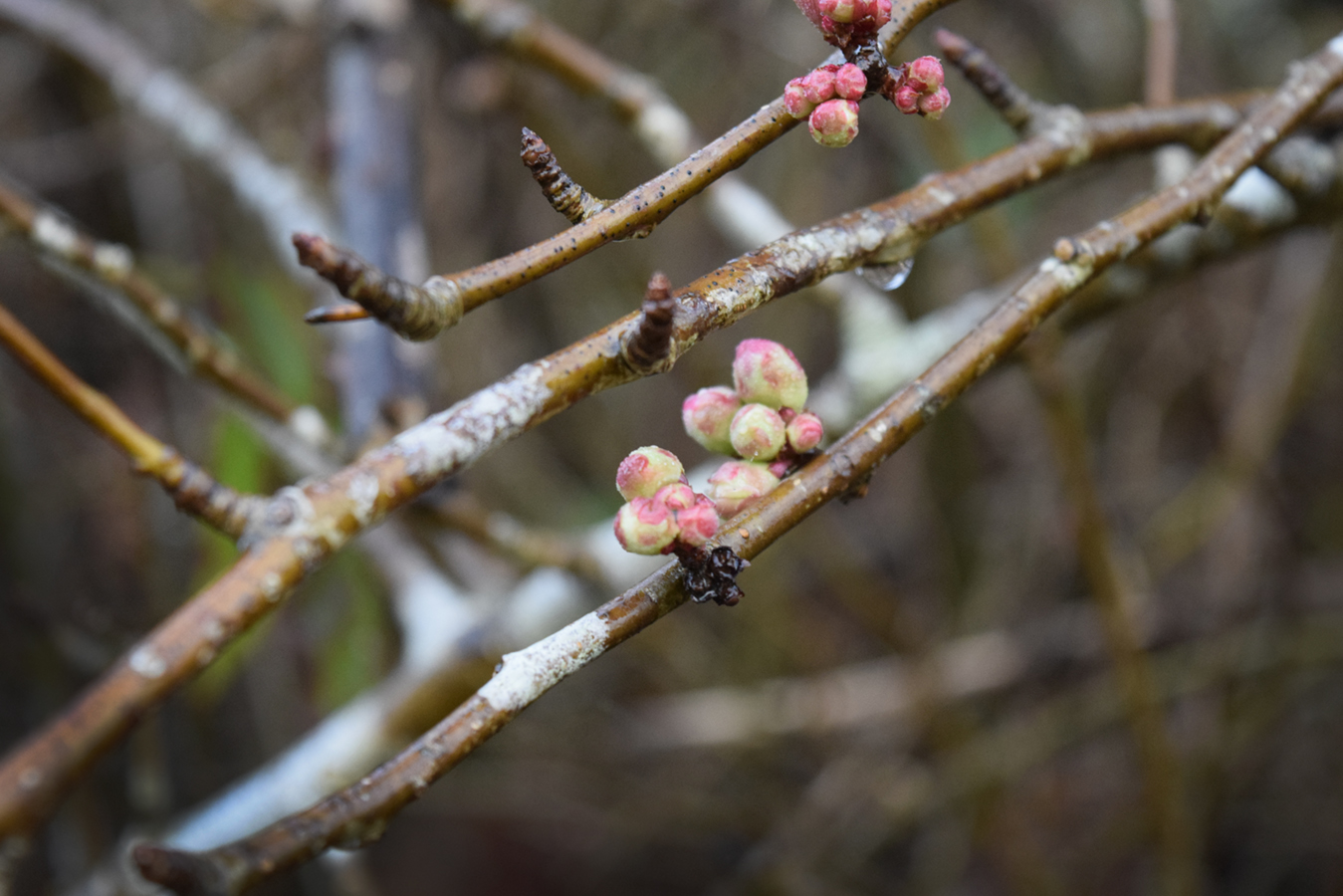
Today, I spotted the first buds of the flowering quince shrub just starting to emerge. I suppose it hasn’t been so cold this winter to keep that from happening, but I was surprised to find them nonetheless. This particular shrub is a volunteer, though I think it might have originated from some plantings that my grandmother had done for a lath-house that used to stand where the quince is now.

Flowering Quince, or Chaenomeles, is a genus of three species of deciduous spiny shrubs, usually 1–3 m tall, in the family Rosaceae. They are native to Japan, Korea, China, Bhutan, and Burma. (Burmese: ချဉ်စော်ကား) These plants are related to the quince (Cydonia oblonga) and the Chinese quince (Pseudocydonia sinensis), differing in the serrated leaves that lack fuzz, and in the flowers, borne in clusters, having deciduous sepals and styles that are connate at the base.

The leaves are alternately arranged, simple, and have a serrated margin. The flowers are 3–4.5 cm diameter, with five petals, and are usually bright orange-red, but can be white or pink; flowering is in late winter or early spring. The fruit is a pome with five carpels; it ripens in late autumn.

Chaenomeles is used as a food plant by the larvae of some Lepidoptera species including the brown-tail and the leaf-miner Bucculatrix pomifoliella. (From a page at Wikipedia – https://en.wikipedia.org/wiki/Chaenomeles).

The canes and flowers are often a favorite with floral designers, as they hold their form and lend as a bright, sturdy backdrop for other things, or are lovely by themselves. Butterflies love this shrub.

When I lived in California, I had a job working as a landscape assistant to a fellow who had been trained in his craft by a Japanese gardener. Much of his aesthetic around gardening and gardening maintenance reflected that sensibility and I learned much from him (to add to earlier knowledge gleaned from my parents and grandparents).

I suppose that that was the time I first became aware of bougainvilleas, as we tended several large patches of them at one of the old estates (pre-1991 Oakland Hills fire). They looked so much like the flowering quince that has been here on my family’s property, from the time that I was quite little, that I nearly felt like I was back at home. My first, goofy meeting with the bougainvilleas was to wade right in with the purpose of thinning and collecting some canes. Much to my surprise, these ‘quince’ had quite the monstrous thorns. They chewed up my lower arms and pricked my hands to a fare thee well before I could favorably extract myself.

It was when I told my wife (at the time) about the incident, about having waded into a thicket of quince, to be mauled instead by bougainvilleas, that I learned another interesting fact about quince. When she asked me to repeat what I thought I’d been dealing with she said, “Quince. Quince? Spell it.” So, I did. “Oh!” she remarked. “You mean queens!” I told her I had no idea what she was talking about. “Queens,” she rejoined me. “That’s how I learned to call them from my Portugese Vovó (grandmother).”

The Great Leveling

In 1964 my grandparents were robustly involved in their little landscaping and nursery business here. My grandmother was particularly fond of cacti and had been collecting, nurturing and transplanting a lovely variety of cacti since before I was born.

Toward that endeavor, she and my grandfather had built a greenhouse dedicated primarily to cacti, with plumbed water, a potting and soils mixing area, and racks and racks of cacti arranged sensibly for ease of access and for paths around, such that one didn’t have to be too concerned about getting stuck with thorns. The structure even housed a little cast-iron wood stove to help keep the temperature up in the winters.

My favorites among the cacti were the barrels, and grandma had one or two that were very old and large. When I was a wee child I loved going in to the greenhouse, helping with cultivation and watering, and wondering at all the textures and colors. Among all the different kinds of plants and shrubs that my grandparents tended and sold, the cacti seemed the most popular.

Sometime while I was away at college in the 1970s the coast experienced a very harsh winter with sub-freezing temperatures. At the same time a particularly nasty strain of the flu was going around and my grandparents and parents all caught it.

That flu pretty well laid everyone up with just about every flu symptom known, and they mostly kept to bed for the duration. One night, there was a very hard freeze, with temperatures in the low teens. While the wood stove had been started earlier in the night, it went out around ten or eleven o’clock. Everyone was too sick to get up and check on the greenhouse, assuming that it was alright. By morning, every cactus in the greenhouse had frozen beyond saving. My grandma didn’t get out of bed for many more days.

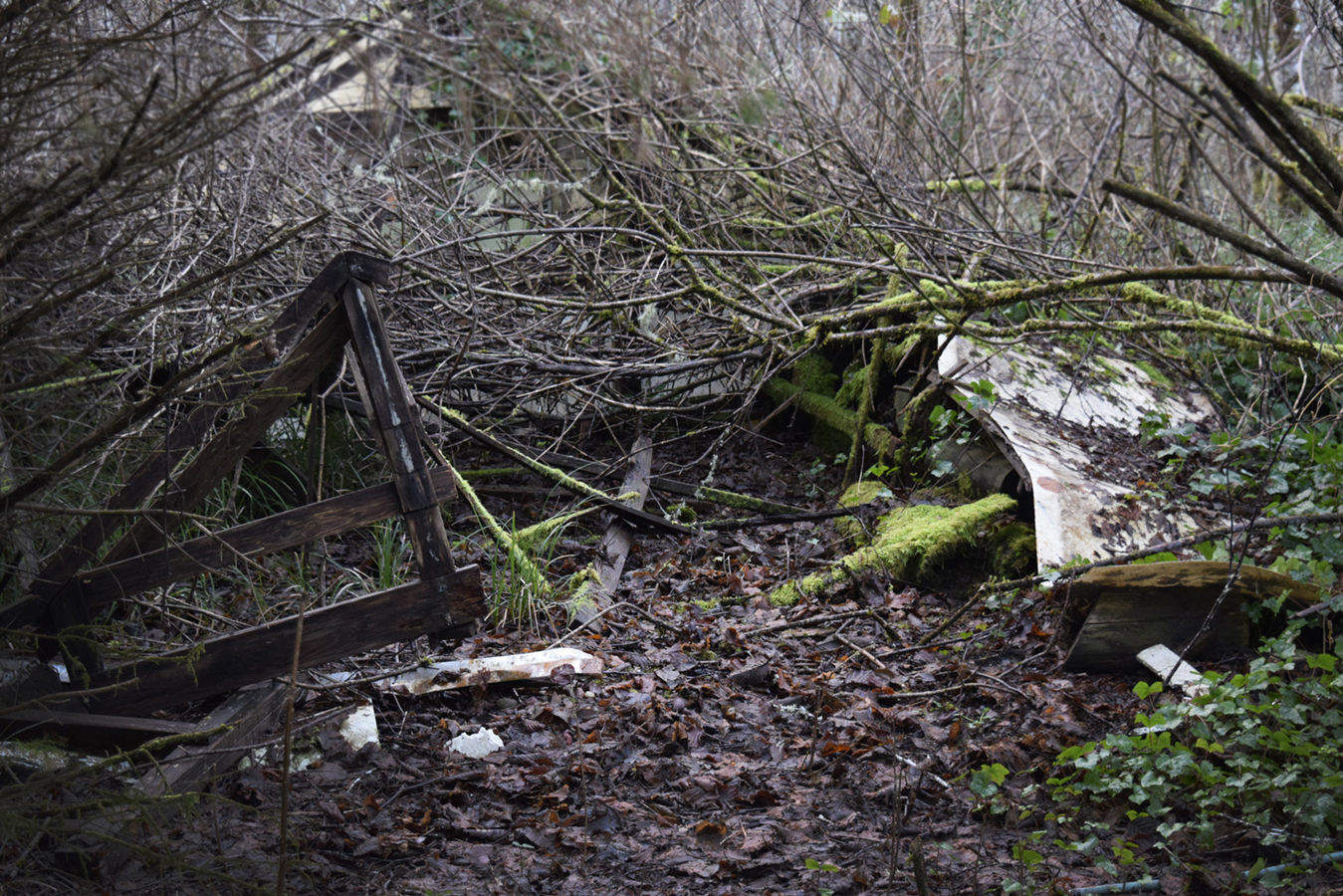
Today, the greenhouse is just a tangle of vine maple, willow, ivy and mosses.

The Last Apple

This fall I’d been anxiously waiting for the half-dozen or so apples on the little Dwarf Macintosh to ripen up. Most folks with any experience assured me that when the apples were ripe, they’d begin to fall off the tree.

One day, I was away all day. When I returned home it was dark, and I gave little thought to the apples outside. In the morning, I opened the front door to let in some fresh air and light.

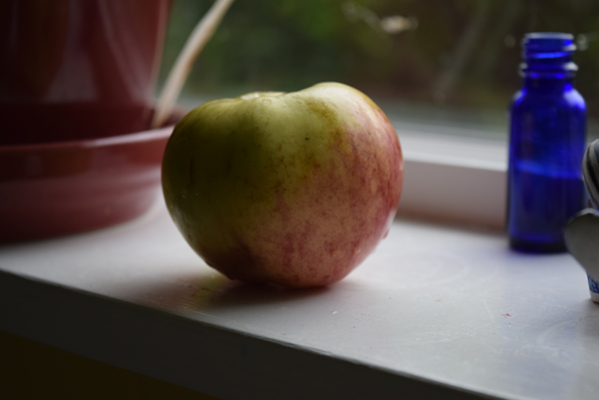
Just outside was this little buck, eating something from the ground. When he saw me he raised his head and I could see a very robust apple in his mouth. I realized that the apples must have started to drop, so I went out to have a look. Of course the buck started and trotted off, dropping the apple as he left. Looking around, I could see that it was the only one; none in the tree, no more on the ground.

The apple was nearly pristine, and I thought about just leaving it for the buck for if he should return. Since he’d obviously already gotten the other five, I decided to bring it inside instead, where I washed it up, cut around the barely-noticeable tooth marks, sliced it up and ate it with much good humor.

This blog will be a collection of images from approximately one square acre of the land around my house. Periodically, I’ll discover some little item–a leaf, a rock, a piece of rusty metal, weathered wood perhaps–and will record such with my camera. I’ll upload the image here and comment upon it: what it is, genus, species, composition and tell the story about it. I hope that you will rejoin me with comments upon these subjects.

The Last Apple
The Last Apple